What is a brain map at BBS
The brain map tells us the typical speeds of an individual brain.
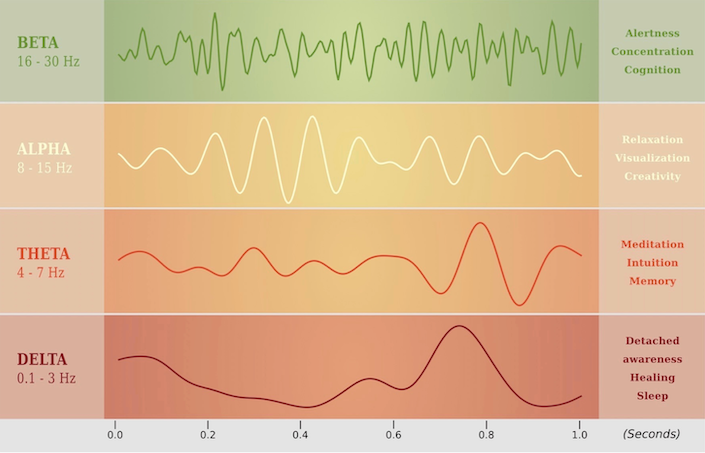
Electrodes placed on your head will pick up on the electricity coming from your brain. The electricity produced by your neurons (brain cells) comes in waves. The frequency of those waves (how many waves occur in one second) is what we mean when we say “speed.” The diagram shows what the different speeds look like on a regular EEG.
A healthy brain needs all four speeds to work together. For example, look at the delta waves on the bottom. Notice how slow delta waves are? They’re great for deep sleep, and we should always have some, but too much of those when you’re awake means your brain feels a little slow and sleepy most of the time. Beta waves, the fast ones at the top, are signs of being highly awake and focused. We need them in order to do anything that requires thought, from basic math or even choosing which words to use. But if we have too much beta, then our brain is going too fast all the time which leads to anxiety and burn out.
What is Neurofeedback?
What’s the Goal?
Based on the personal results of your brain map and your symptoms, we’ve decided what patterns in your brain we want to change. The goal is to change the abnormal speeds to be closer to normal. That change toward normalcy should help your brain perform better and resolve the targeted symptoms.
At Brain Body Science, we train either 1 or 2 regions of the brain at a time. If one of the abnormalities in your brain map is in your frontal lobe (the area around your forehead up to the middle of your head), we’ll put one or two electrodes there. Then, based on the speeds of your brain map, we decide which speeds we want to increase or decrease.
For example, if you have too much delta (the slowest speed) and not enough beta (the fastest speed), we’ll make it the goal to decrease delta and increase beta. If it works, this will speed up that area of the brain, making it less sluggish.
How Does It Work?
When the electrodes are on your head, they sense some of the electricity from your brain that leaked through your skull, and feed that electricity into the amplifier, which feeds into the computer. The computer analyzes the speeds. If we’ve told the program that we want you to have less delta, the computer will give you positive feedback when the levels of delta decrease. It will give you negative feedback when the delta increases. The feedback is second-to-second, so even quick changes to speeds will be rewarded or discouraged.
Don’t worry, we are NOT going to shock you. Neurofeedback does not involve any electrical stimulation—that is, we aren’t going to put any electricity into your brain. (That’s a different kind of therapy called Electrical Brain Stimulation, or EBS.)
The feedback part is surprisingly simple:
You’ll watch a video or play a game on the computer that’s connected to the electrodes. When your brain changes in the way we want it to, the screen will get brighter and the volume will get louder (to comfortable levels). That’s the reward. When your brain shifts away from what we want, the screen will get dimmer and the volume will be quieter (so it’s harder to see and hear, which is slightly annoying). That’s the discouragement.
You may recognize this as operant conditioning: learning to do some behaviors more and others less through rewards and punishments.
For the most part, you won’t really notice the feedback. It’s designed to be subtle enough that your conscious mind will largely forget about it while focusing on your game or video. You don’t need to actively try to make the screen brighter. In fact, that sometimes makes the training less effective. It should mostly be a subconscious process.
If you enjoy the video or game, your brain will want to be able to see and hear it as well as possible. Naturally, your brain will get mildly annoyed when that becomes more difficult, so it will automatically try to shift the speeds of the training location so that it continuously gets the reward of getting to see and hear well.
How Long Does It Take?
After many sessions of repeating these changes, your brain will begin to stick with those ideal speeds even when you’re not training. Like with learning anything, it will take time, so please do not expect results instantaneously.Especially if your brain has been operating with these same dysregulated/abnormal speeds for many years or decades, it can take a long time for them to change permanently. It’s like a bad habit you’ve had for all that time, and we all know how hard it can be to break longtime bad habits.
The necessary number of sessions varies a lot from person to person and depends on the severity of symptoms, degree of abnormality, and quality of training. It generally takes at least 10 sessions before people notice any significant changes in their symptoms. It takes about 15-20 sessions before those changes become permanent. Some people do respond sooner than that, but please be patient with your brain if it takes longer.
How Do We Know If It’s Working?
We use BrainCore/Synapse neurofeedback software. This program allows us to see the data from your training in real time, and we can refer back to it later. This data measures the changes in each frequency band (the different speeds), the asymmetry in alpha and beta, the activation (essentially, how engaged your brain is), and the training efficiency. We can also see if muscle tension artifact or bad electrode connections are affecting the training. We’ll use this data to track your progress and make necessary changes to your training.
Are There Risks or Side Effects?
Side effects of neurofeedback tend to be uncommon, mild, and temporary. Most people who go through training do not report any. The most common side effects are headaches or sleep disturbances on the day of or day after training. Some people have reported longer sleep disturbances or increased irritability. If you notice any side effects that are severe or last a long time, please let us know.
In very rare cases, the changing of brightness from the feedback may trigger a seizure in people with photosensitivity. If you have ever had a seizure, migraine, or are sensitive to flashing lights, please inform us prior to beginning training. We can adjust the settings appropriately for you.
What is Neurofeedback Best for?
Studies have found neurofeedback to be very effective for ADHD-related symptoms (especially for improving attention), and some research has shown it to be an effective adjunctive therapy for numerous other neurological conditions, such as TBI, depression, anxiety, and mild cognitive problems. Neurofeedback may be used as an adjunctive therapy for FND or psychogenic seizure disorders as well.
In our practice, we have had many clients report significantly improved mood, memory, cognitive ability, and sleep quality, among other positive effects. Typically, neurofeedback alone does not 100% resolve symptoms, but nearly all of our clients who have completed training reported some degree of improvements to their symptoms. Some of our clients have reported a complete resolution of symptoms, especially symptoms more easily measured (ex: number of psychogenic seizures, hours of sleep per night, performance on cognitive tests, etc.). We encourage and support our clients in making healthy lifestyle changes while undergoing training for a more holistic approach to improving symptoms.